Google Business · Meta & ChatGPT ads · Direct mail

Your next customer already knows what the job costs. Yours.

Three lead engines, run for you: your Google profile climbing the map pack, your ads on Meta and ChatGPT with creatives proven in your trade, and mailers to the neighborhoods you draw on a map. Every homeowner who bites sees a real price built from your numbers before they ever call — and in your ad zones, nobody else in your trade gets that lead.

Get set up — talk to us

You keep 100% of every job. We never take a cut of your contract.

Owner of a local contracting business

Three lead engines. One place. You approve, we run.

Each one works on its own. Together they cover the three ways a homeowner actually finds a contractor: they search, they scroll, and they check the mail.

When they search
Google Business

The map pack is where local jobs are won, and Google ranks the profiles that stay complete, get answered reviews, and post regularly. Almost nobody in the trades does all three. We do it for you, every week.

  • Profile kept complete and current — services, hours, service area, photos
  • New reviews fetched automatically and answered in your voice
  • Regular posts about the work you actually do, so the profile never goes quiet
  • Rank and review movement tracked in your dashboard
Free with any Outfitter account. No ad spend involved. How it works ↓
When they scroll
Meta & ChatGPT lead flow

Your ads on Facebook, Instagram and ChatGPT, using creatives that have already produced jobs in your trade. The homeowner who clicks designs the project with Emma, sees a price range built from your numbers, and asks to talk. You get the lead with the estimate attached.

  • Proven creatives for your industry — no ad manager, nothing to approve every week
  • Exclusive zones of ~300,000 people: one contractor per trade, per zone
  • Every lead texted to you the moment it’s ready, scope and price range included
  • Spend, reach, clicks, leads and cost per lead, live
You fund the ad budget at cost plus our 30%. See a real ad ↓
When they check the mail
Direct mail

Draw a fence around the neighborhoods you want on a map. Work with the AI on the design until it looks like you. Set how often it goes out. Approve it in one spot. It prints, it mails, and every piece carries a code so you know which streets called.

  • Pick areas by drawing, not by ZIP code — the streets around your last three jobs, the subdivision with the right-age houses
  • Household count and total cost shown before you approve anything
  • Postcard designs built with the AI from your photos, offer and brand
  • Monthly, seasonal, or one-time drops — your call, changeable any time
Print and postage at cost, quoted before you approve. See a sample piece ↓
Engine 1 · When they search

Text her the customer. She gets the review and makes the post.

Finish a job, then send one text to your Front Desk number: the customer’s name and cell, and a couple of photos of the finished work. That’s the whole job on your end.

  • She asks for the review — a text to the customer in your voice, with the photo of their project and one tap to Google. If they don’t get to it, she follows up once, a few days later, and then leaves it alone.
  • She answers every review — new reviews are pulled in as they land and answered within the hour, in your words. The five-stars and the three-stars.
  • She makes the company post — the same photos become a Google post about the work you actually do, in the neighborhood you actually did it. Weekly, so the profile never goes quiet.
  • She keeps the profile complete — services, hours, service area, photos. The unglamorous stuff Google ranks on.
36%
of map-pack ranking is your Google Business Profile
Whitespark, 2026 Local Search Ranking Factors
16%
is reviews — how many, how recent, how steady
Whitespark, 2026
73%
of people only weigh reviews from the past month
BrightLocal, 2026
17%
of local businesses ever post on Google — weekly posting gets 28% more profile actions than monthly
BrightLocal / SOCi, 2026
Engine 2 · When they scroll

You get the ads that already work. Not a blank canvas.

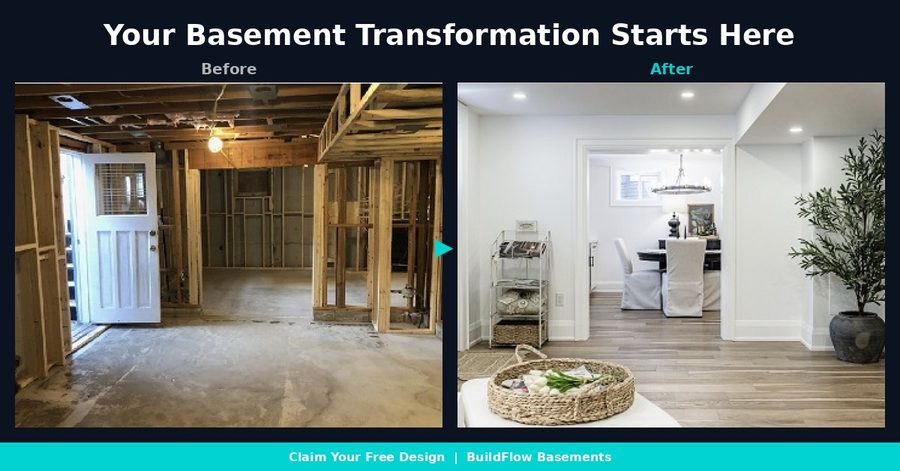
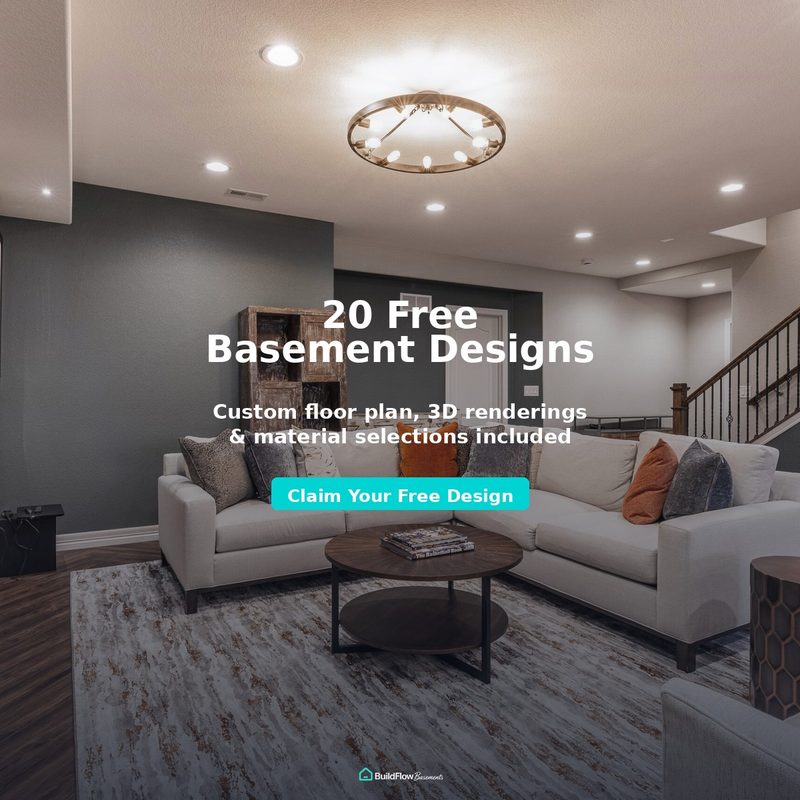
That’s a real ad. It runs for BuildFlow Basements, the basement-finishing company we own and operate in the Twin Cities — the business we built this whole system on. Every angle, format and line of copy has been tested with our own money before it goes anywhere near yours.

  • Proven angles, swapped to your trade — the offer, the aspiration and the urgency versions; square, landscape and vertical; static and video. We change the photos, the trade and the offer. The structure that pulls stays.
  • Meta and ChatGPT, same budget — Facebook and Instagram feeds, plus sponsored placements inside ChatGPT, where homeowners now ask “who does drainage near me.”
  • The click lands on Emma, not a form — the homeowner designs the project, sees a price built from your numbers, and asks to talk. You get the lead with the estimate attached.
  • Your zone, nobody else’s — one contractor per trade per ~300,000 people. Ad spend at cost plus our 30%; add or drop zones for next month any time.
Engine 3 · When they check the mail

Direct mail to the streets you choose.

How direct mail works
Draw it. Design it. Approve it. It mails.
1
Draw a fence on the map

Not ZIP codes — the actual streets. The blocks inside your fence become USPS carrier routes, and you see the household count and cost per drop before anything else happens.

2
Build the postcard with the AI

Your photos, your offer, your brand. Change it until it looks like you. Every piece carries a code so you know which streets called.

3
Set the frequency and approve

Monthly, seasonal, or one-time. One approval screen with the design, the map and the total. Print and postage at cost, then it’s in the mail.

Most of your market never even starts.

The homeowner who wants the work done doesn't know what it costs. The only way to find out is to let three salespeople into the house — be home, two hours each, get pressured, and half the time still not get a number.

So they don't. They sit on it for another year. They're not comparing you to a competitor; they're comparing doing the job to doing nothing, and doing nothing keeps winning because it's the only option with a known price.

That's the part we built. A homeowner spends five minutes on their phone, designs what they want, and sees a real number — yours. The ones who like the number ask to talk to somebody. That somebody is you, and only you.

The estimator running on a phone
Meet the agent doing the work

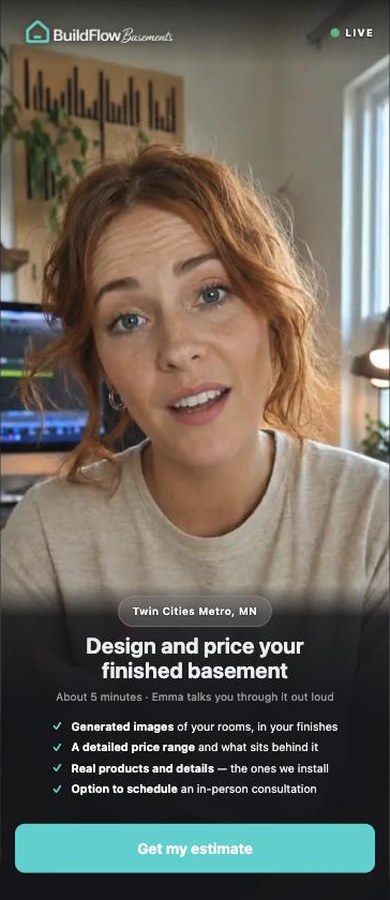
This is Emma. She does the part you hate.

She talks the homeowner through their project out loud — what they want, what moves the price, what they're actually choosing. They see generated images of their own rooms in their own finishes, a real price range, the products you'd install, and an option to book time with you.

No forms. No callback-during-business-hours. No salesperson in their kitchen. Five minutes on the couch, and by the end they know what it costs and who's building it.

Ignore the fact that it's basements. That's the trade we built first and proved it on. Go through it the way a customer would — answer the questions, pick the finishes, watch the number come back — and notice everything you'd know before you ever got in the truck. That's the part that gets built for your trade.

This is the live system, not a video. Mic optional — you can type instead.

You already know what a bought lead feels like.

The lead you buy today
  • Sold to four other contractors at the same time
  • A name and a phone number
  • You call. They don't remember filling anything out
  • They're collecting quotes — you're competing on price before you've said a word
  • You find out standing on the job that it was never real
The lead you get here
  • Yours. Nobody else in your territory gets it
  • Scope, photos, selections, and the range they already saw
  • They spent five minutes designing it. They remember
  • They're not shopping — they asked to hear from you specifically
  • Budget was settled before you drove anywhere
What happens before they ever reach you

Five minutes, at 10:30 at night, with nobody watching.

Alone on the couch there's no salesman watching their face when the number lands. They can find out it's $40,000 and close the laptop with zero awkwardness — which is exactly why they'll actually do it.

  1. 1

    They see the ad and tap it

    No form promising a callback during business hours. The estimator opens right there, branded as your company from the moment they enter their ZIP.

  2. 2

    They walk the project

    Our agent asks what they want done, walks them through the choices that actually move the price, and has them point their phone at the space. No forms, no jargon, no homework.

  3. 3

    They get something real

    A price range built from your rates. Renderings of what they picked. Materials. A week-by-week timeline. Not a brochure — their project.

  4. 4

    They decide whether to hear from you

    No pressure, and we mean it — the estimate is theirs whether they book or not. The ones who say "yes, have them call me" are the ones that reach your phone.

What actually lands in your inbox

Not a name and a number. Everything they told us and everything we showed them — so your first sentence is about their project instead of twenty questions.

Scope

Measurements, conditions, what they want done and where — with the photos they took while we talked.

The number they saw

The exact range we quoted, built from your rates. You arrive already aligned instead of re-anchoring them.

Their selections

Finish level, materials, the upgrades they picked and the ones they passed on.

What we flagged

Where the estimate was uncertain and why — access, age, what's behind the wall — so you know before the driveway.

Timing

When they want it done, and whether this is urgent or something they're planning for next season.

Consent

Whether they asked to be contacted or would rather reach out themselves. You never cold-call someone who didn't.

Your numbers, not ours

What would a pipeline like this be worth to you?

We're not going to tell you what you'll make — we don't know your close rate and neither does anyone else selling you leads. Put your own numbers in. The only figure we supply is what a lead costs, and you can move that too.

$1,000$10,000
$50$300

This is the one number we're guessing at. Early data only — drag it and see how much it matters.

5%50%

Be honest. These arrive with a budget already settled, so it should beat your cold number — but you know your own closing.

$2k$120k
Leads per month13
Jobs won1.6
Cost per job won$1,250
Contract value$64,000
Per $1 of ad spend$32

This is arithmetic, not a forecast, and definitely not a guarantee. It multiplies the numbers in the boxes — nothing more. Your actual results depend on your market, your pricing, how fast you follow up and how well you sell. Some contractors will do better than this. Some will do worse.

Want this as a one-page PDF with your numbers in it?

Set up with a person, not a checkout

Tell us your trade and your area.

Marketing isn’t a self-serve button. Every account is set up by hand — we check whether your ad zone is open, look at your Google profile, and map the neighborhoods you want mailed — then we walk you through it before anything is charged. Send this and you’ll hear from us within one business day.

Which engines are you interested in?

How the money works

Free to join

Google Business upkeep, the ad program, and direct mail, managed for you. Marketing is free to join, and Google posts and review requests are free. Everything else runs on tokens (1 token = 1¢): ads and mail at cost plus 30%. There's no checkout button — we set each account up by hand and confirm the numbers with you first. See the pricing page.

You fund the reach

Ad spend is yours, at cost plus our 30%, prepaid by the zone. Print and postage for mailers are at cost plus 30%, quoted per drop before you approve. Nothing runs that you haven't seen the number on.

You keep 100% of the job

No commission, no revenue share, no piece of your contract. We're not in the room when you sell, and we never take a cut of what you build.

Every dollar and every lead is visible in your dashboard — ad spend, mail drops, review movement, leads, what each one was quoted, and what came of it.

Straight answers

How is this different from Angi or Thumbtack?

They sell the same homeowner to four or five of you and let you fight over price. We sell a territory to one contractor. The homeowner talks to you or to nobody.

Where does the price range come from?

Yours. Before your ads run we capture how you actually price work — rates, production, materials, tiers, your minimum, your exclusions. The estimator runs on your numbers, not an industry average.

What if the estimate is wrong?

It's presented as a ballpark from someone who hasn't seen the property, and it names exactly what could move it. You give the real number after you've looked. The range exists so nobody wastes a trip on a budget that was never going to work.

I don't run Facebook ads. Do I need to learn?

No account, no ad manager, no creative to approve, no targeting to set. You pick a budget and work the leads.

What happens when I'm booked out?

Tell us and we throttle or pause your territory. Exclusivity means your leads don't go anywhere else, so it's on us not to send you more than you can handle.

What does exclusivity actually cover?

Your trade, in your zones — slices of your metro with about 300,000 people each. A zone you pay for is yours; we won't sell it to another contractor in your trade while you hold it, and zones nobody has claimed send their leads to you too. A plumbing partner and a roofing partner can share a zone — they're not competing for the same homeowner.

What does the Google Business part actually do?

The three things Google rewards and contractors never keep up with: a complete, current profile; reviews that get answered; and regular posts. We pull new reviews in as they land and answer them in your voice, keep services, hours, photos and service area current, and post about real work on a schedule. You see rank and review movement in the dashboard. It's included in the Marketing plan, with no ad spend attached.

How does the direct mail work?

Open the map, draw a fence around the neighborhoods you want — not ZIP codes, the actual streets. We turn that into USPS carrier routes and show you the household count and the cost before you do anything. Then you build the postcard with the AI from your photos, offer and brand, pick monthly, seasonal or one-time, and approve. It prints and mails; print and postage are billed at cost. Each piece carries a code so you know which drop the call came from.

Ads on ChatGPT — is that real?

Yes. ChatGPT now carries sponsored placements, and homeowners are asking it "who finishes basements near me" the same way they used to ask Google. We run your trade's proven creatives there alongside Meta, from the same budget, into the same estimate-first flow.

Do you take a percentage of my contracts?

No. Our fee is a percentage of the advertising spend, charged up front. What you sell and what you make on it is entirely yours.

Sources
  1. Whitespark, Local Search Ranking Factors 2026 — survey-weighted share of local pack ranking by factor group: Google Business Profile signals 36%, review signals 16%. whitespark.ca
  2. BrightLocal, Local Consumer Review Survey 2026 — 87% of consumers read reviews for local businesses; 73% only pay attention to reviews written in the past month. Compiled in Searchlab, Google Business Profile Statistics 2026.
  3. SOCi / BrightLocal 2026 — 17% of local businesses use Google Posts; weekly posting produces about 28% more profile actions than monthly. Same compilation as above.