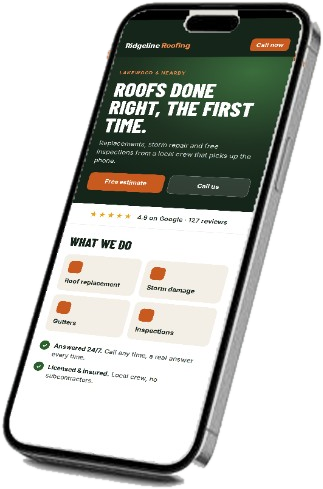
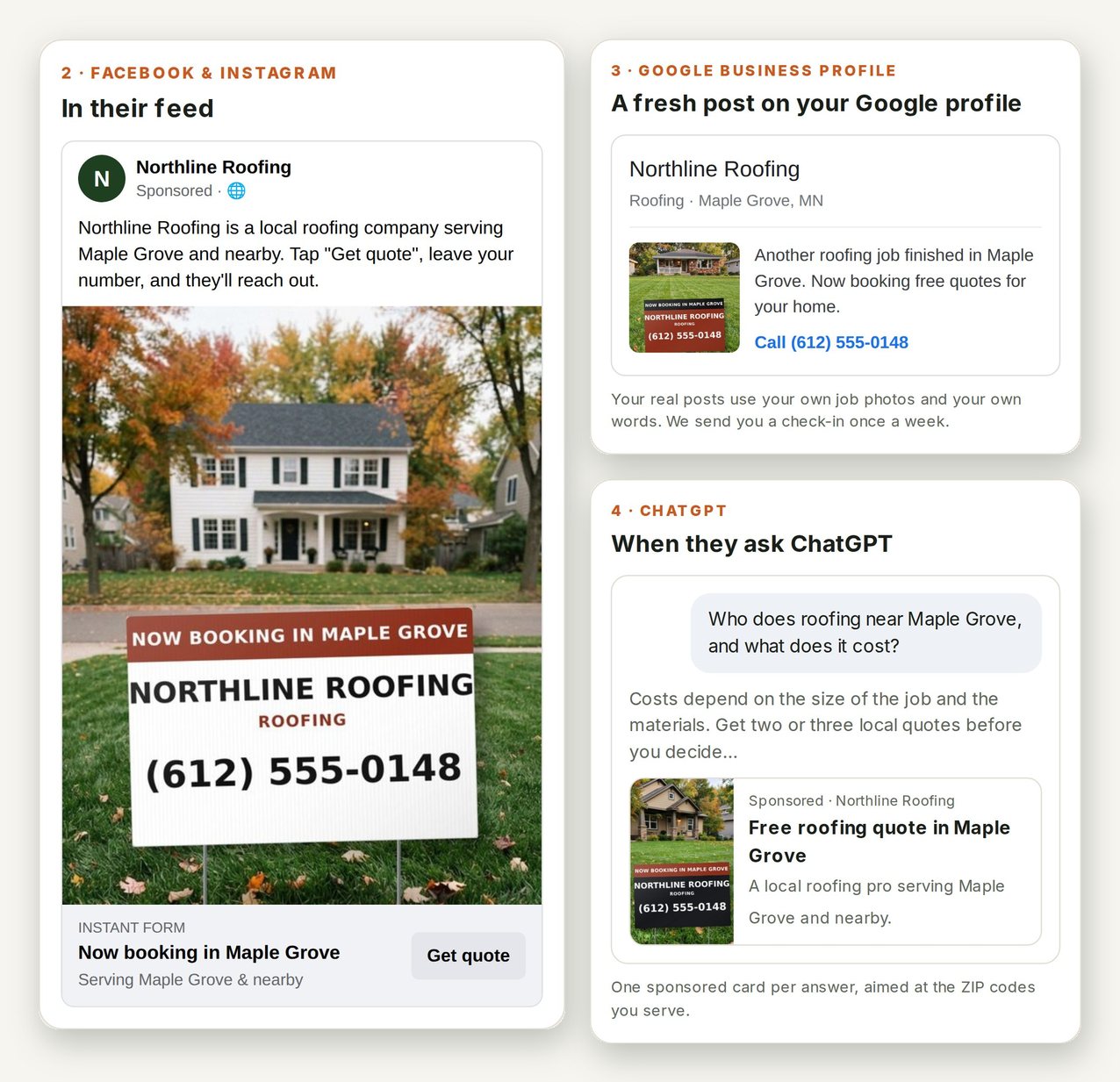
You build fences in June, clean gutters in October, hang lights in November and plow at 4 am in January. Outfitter gives your outdoor services company a website that covers every season, an AI Front Desk for the calls you can’t take from a ladder or a plow truck, and ads that change over with the calendar, run by Emma, your AI agent.
Call or text Emma the way you’d talk to an office manager. She does the rest.
Asks your questions, offers the homeowner a time and texts you the details to confirm.
Built for your trade in about five minutes, from what already wins work.
Six numbers for owners who change services with the weather, from snow contracts to fence quotes. Sources are linked at the bottom of the page.
The hard part isn’t the work. It’s switching what you sell, to whom, before each season starts. Emma swaps your ads, website highlights and Front Desk questions as the calendar turns.
Spring cleanup and gutter ads go out as the snow melts. Front Desk pre-schedules fence and deck estimates so summer builds are lined up.
Build season. Review requests follow every finished fence. Late summer, Emma starts selling fall gutter cleanings and next winter’s snow contracts to your list.
The busiest changeover. Leaf cleanup and gutter ads in September, holiday light bookings in October, installs in November, and snow contract postcards to past customers.
Front Desk answers during storms and flags missed driveways and icy walks as urgent. Light takedowns get pre-scheduled after the holidays, and spring hiring ads go out.
Your mix depends on your snow belt. A company outside Buffalo lives on plowing, while one in Nashville may hang lights and skip snow entirely. Emma builds the calendar around the services you actually sell.
Storm days, leaf days and light-install weekends all hit when your hands are full. Front Desk answers your number, knows which service the caller is asking about, flags the urgent ones and pre-schedules the rest for you to confirm.
Example call. Front Desk follows the rules you give it.
A homeowner looking for a light installer in October has no idea you built their neighbor’s fence in June. Reviews that mention each service, and a site that lists all of them, tie your seasons together.


Tell Emma every service you offer and your site is live in about 5 minutes. When the season turns, text her: “Put snow contracts at the top.”
Three cost changes that show up in fence, gutter and lighting quotes. Customers notice higher prices, so explain them on your site and on the phone before they ask.
For context: BLS notes that grounds maintenance crews often shift to snow removal in winter, and SIMA found snow and ice providers keep about 93% of customers year to year. Check with your suppliers before quoting materials. [10] [1]
BLS counts about 1,299,200 grounds maintenance jobs, with a median $19.27 an hour in May 2025, and notes that many are seasonal with winter work like snow removal. That means competing for the same people every spring and fall. [10]

Call or text one number. Emma, your AI agent, runs your website, your ads, your phones and your hiring, set up for your outdoor services company.
Every service you offer, with whatever’s in season moved to the top by text.
Gutter and leaf ads in fall, light bookings in October, snow contract postcards, fence ads in spring.
Picks up storm-day and ladder-day calls, flags missed plows and icy walks, pre-schedules the rest.
Seasonal job ads for plow drivers, light installers and fence crews, with every applicant sent to you.

Example conversation.
A practical guide for companies that change services with the weather, from fences and gutters to holiday lights and plowing: how to present it all on one website, time your ads to each season and handle the phone when every call is about something different.
On this page: Website · Marketing & ads · Phone calls · FAQ · Sources
Build separate pages for gutter cleaning, spring and fall cleanups, fence installation, decks, holiday lighting and snow removal. Each needs its own photos, what’s included and how you price it. One combined services page can’t rank for “Christmas light installation near me” and “fence company” at the same time.
Your home page should change four times a year. Feature fence and deck estimates in spring, gutters and leaf cleanup in early fall, light bookings in October and snow contracts before the first storm. A visitor in November who sees fence photos assumes you’re closed for the season.
Seasonal buyers want to know exactly what they’re signing. For snow, list the trigger depth, what’s cleared, salting, and per-push versus seasonal pricing; Angi puts residential seasonal contracts around $300 to $700 [2]. For lights, say whether takedown and storage are included. Clear terms cut down on calls and disputes.
List your insurance, any required contractor license for fences and decks, and years in business. Customers are letting you on their roofline and promising you their driveway at 5 am, so trust matters. Use real photos: lit-up houses at night, finished fences, plowed driveways with the truck in frame.
Use one short form with a service picker, so the request shows up already sorted. Add tap-to-call on every page and ask for an address up front, since you’ll price gutters, lights and snow from the property. Outfitter’s site sends each request to your email and offers live AI booking for estimates.
Choosing who builds it? 18 website options compared, with first-year costs and who owns the site.
Seasonal buyers decide early. Run gutter and leaf ads in late August, holiday light ads in early October, and snow contract ads from September until your routes are full. Fence and deck ads start in late winter. Ads that start when the season does are already behind.
Your gutter list is your best snow list, and fence customers make good light customers. Email, text or mail past customers before each changeover with a simple offer. SIMA found most snow providers run more than one service line and keep about 93% of customers year to year [1], which is the whole case for cross-selling.
Seasonal snow contracts are your most predictable winter revenue. Sell them in September and October with a firm deadline, and offer a discount for signing early or bundling with fall cleanup. Per-push customers who call mid-storm are harder to schedule and easier to lose.
Ask for reviews after fences, gutter visits, light installs and the end of snow season, so your profile shows every service. Buyers weigh recent reviews heavily [6], and a profile that went quiet in March looks inactive when people shop for spring work. Reply to each review and name the service.
Add each service you sell to your profile, pick categories that match your main lines, and post seasonal photos as you switch: lights in November, plow trucks in January, fences in May. Update your hours and storm-day availability so Google and AI tools show current information.
Set a separate ad budget for each season and judge it by booked jobs and contract value, not clicks. Light installs and snow contracts often cost less to win from past customers than from new ones. Drop the channels that didn’t produce after a full season, then shift that money to the next changeover.

Choosing where to spend? 26 marketing options compared, including which leads are shared with other contractors.
Your phone covers six different jobs, so start every call by asking what they need help with. Then switch to that service’s questions. A caller asking about lights doesn’t want to hear about fences, and a snow customer at 5 am wants to know someone heard them.
Gutters: stories, linear feet if they know it, and guards. Fences: length, height, material and whether property lines are marked. Lights: rooflines and stories, and whether they own lights. Snow: driveway size, walks and steps, and when they leave for work. Satellite maps fill in most of the rest.
During a snow event, contract customers who weren’t plowed come first, then icy walks and steps. Decide in advance who gets routed when, and get the address and the exact problem on every call. Have a way to answer when you’re plowing, so a missed driveway doesn’t become a cancelled contract.
For gutters, lights and snow, you can usually quote from satellite images and the caller’s answers without a visit. Send the price by text with the install or start date. For fences and decks, set an on-site estimate with a date before you hang up.
Seasonal quotes expire on their own when the weather changes. Text open light quotes before your November calendar fills and open snow quotes before the first forecast. A short reminder about limited spots is honest and works. Note why people decline to fix your pricing for next year.
Choosing an answering service? What it should ask and which ones fit this trade, from live answering to AI.
Sell the next season to the customers you already have. Your gutter list is your best snow list, and your fence customers are prime for holiday lights. Postcards and ads to past customers cost less than finding new ones.
Then switch your website and ads before each season starts, not after. Emma does the changeover when you text her, so the right service is up top when people start searching.
Front Desk costs 35 cents a minute, paid from your token balance; $35 covers about 100 minutes. A seasonal snow contract typically runs $300 to $700, so keeping one storm-day caller from hanging up pays for a long stretch of answering.
It answers every call, takes the address and problem, and marks missed driveways and icy walks urgent so you get a text right away. It never promises an arrival time unless you’ve told it what to say. You decide which truck goes where.
Yes. Front Desk says it’s an AI assistant at the beginning of each call. It can sound like you, using a clone made only from a recording you make yourself, or use a natural voice. Callers are never misled.
Early fall, so your November install calendar fills before the rush. Professional installs average about $444, and many installers bundle takedown and storage. Emma can run your light ads in October and turn them off when you’re full.
Late summer and fall, before the first storm. Seasonal residential contracts run about $300 to $700, and signing them early gives you predictable winter revenue. Postcards to your gutter and cleanup customers are a good place to start.
Request a review after each job, whatever the season, and the reviews will naturally mention fences, gutters, lights and snow. Nearly three in four consumers look for reviews from the past three months, so a profile with nothing new since summer looks closed. Emma handles the asking, season after season.
Yes. A Google profile lists your categories, but your website is where you show every service, explain snow contracts and light packages, and take requests. AI tools also read it to decide what you do. Yours can be live in about 5 minutes.
Budget per season, not per year, and judge each by booked jobs. You choose the ad spend with Outfitter and can change it whenever you like. Ads run at cost plus 30%, the first $10 of Facebook ads is free, and there’s no contract.
Tariffs. Since June 4, 2025, imported steel and aluminum and many products made from them carry a 50% tariff, and since October 14, 2025, imported softwood lumber carries 10%. Check with your suppliers and update your pricing before quoting.
Post separate ads for each season, with the pay, hours and on-call expectations stated plainly. Plow drivers need to know they’ll get calls at 3 am; light installers need to be comfortable on ladders and rooflines. Emma runs the ads on Facebook and Instagram and sends you every applicant.
Many do. SIMA found about 85% of snow and ice providers run more than one service line, and BLS notes grounds crews often switch to snow removal in winter. It keeps your best people on payroll year-round, but price in equipment, salt and insurance first.
It works next to it. Every call, request and applicant is texted and emailed to you, so you keep using whatever you already run your jobs in.
There’s no catch. The free website sits at getoutfitter.ai/site/your-name with a small Outfitter banner and remains free. Website Professional, at $79 a month, adds your own web address, drops the banner and automates Google review requests and posts. Try it free for 30 days with no contract. Your business data is yours.
Figures on this page come from these reports. Vendor research is labeled as such; government sources are primary.
Kick off with your outdoor services website, online in about 5 minutes. There’s no fee to join marketing; you pay for what runs, season by season. No contracts.