In HVAC, the phone rings hardest on the hottest and coldest days, and often after 5 pm, when you’re on a roof or at dinner. Outfitter gives your HVAC company a website built for HVAC, an AI Front Desk that answers the calls you can’t, and local ads and Google reviews run for you by Emma, your AI agent.
Call or text Emma the way you’d talk to an office manager. She does the rest.
Asks your questions, offers the homeowner a time and texts you the details to confirm.
Built for your trade in about five minutes, from what already wins work.
Six numbers worth knowing before you spend another dollar on leads. Each one links to its source at the bottom of this page.
Demand jumps with the first heat wave and the first cold snap, then goes quiet in spring and fall. Emma plans the year around that, so your techs stay busy in the slow months and nothing slips through in the busy ones.
AC tune-up ads go live ahead of the first hot week. Maintenance-plan reminders go to last year’s customers. Postcards go to neighborhoods full of older systems.
Front Desk picks up when you can’t, marks no-cool calls urgent and texts you the details. A review request goes out after every repair, while the customer is still cool and grateful.
Heating tune-up and safety-check ads. Maintenance-plan renewals. Replacement postcards for systems that barely made it through summer.
Front Desk answers nights, weekends and holidays and flags no-heat calls. Hiring ads run now, so new techs are ready before spring.
The timing follows your climate. A shop in Phoenix and a shop in Minneapolis don’t run the same calendar, and Emma doesn’t treat them as if they do.
The phone is still how most homeowners reach a contractor: 64% of contacts in the residential trades come by phone. Front Desk answers the calls you can’t, on your number or your cell, screens the job, pre-schedules a time and texts it all to you.
Example call. Front Desk follows the rules you give it.
97% of consumers read reviews, and 45% have used an AI tool to find a local business. The HVAC companies that show up have steady, recent reviews and a website that says exactly what they fix and where.


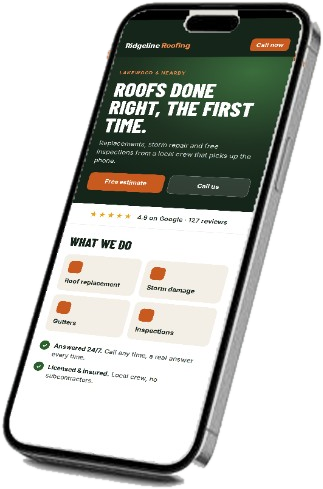
Tell Emma about your business and your site is live in about 5 minutes. Change anything by texting her: “Add a fall furnace tune-up special.”
Three changes that come up on HVAC sales calls this year, in plain English. Keep your website and your phone answers current, and you sound like the company that knows what it’s doing.
For context: U.S. central AC shipments fell 26.2% in 2025 and heat pumps fell 11.6%, while gas furnaces rose 4.1% (AHRI, via Contracting Business). Check your local codes and your distributor before you quote equipment. [13]
The BLS projects about 40,600 openings a year for HVAC mechanics and installers, with a median wage of $61,010 in May 2025. In a Housecall Pro survey of trades pros, 60% said the labor shortage hurt their business and 86% pointed to a lack of qualified candidates. [8] [9]

Call or text one number. Emma, your AI agent, runs your website, your ads, your phones and your hiring, set up for your HVAC company.
AC, heating, heat pumps and maintenance plans laid out the way homeowners search for them.
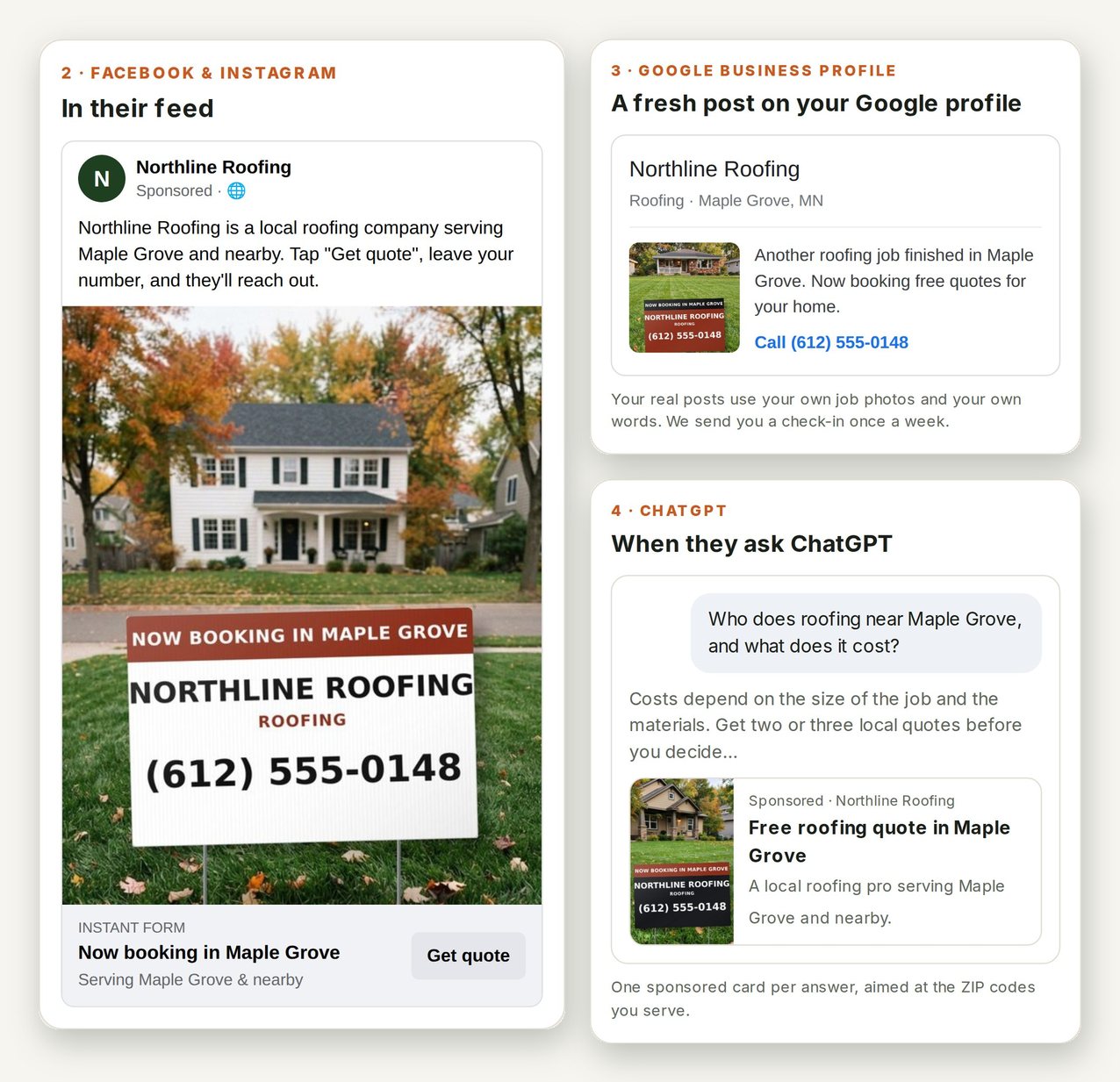
Tune-up ads before each season, review requests after every repair, postcards to older systems.
Answers the calls you can’t, flags no-heat and no-cool calls urgent and pre-schedules the rest.
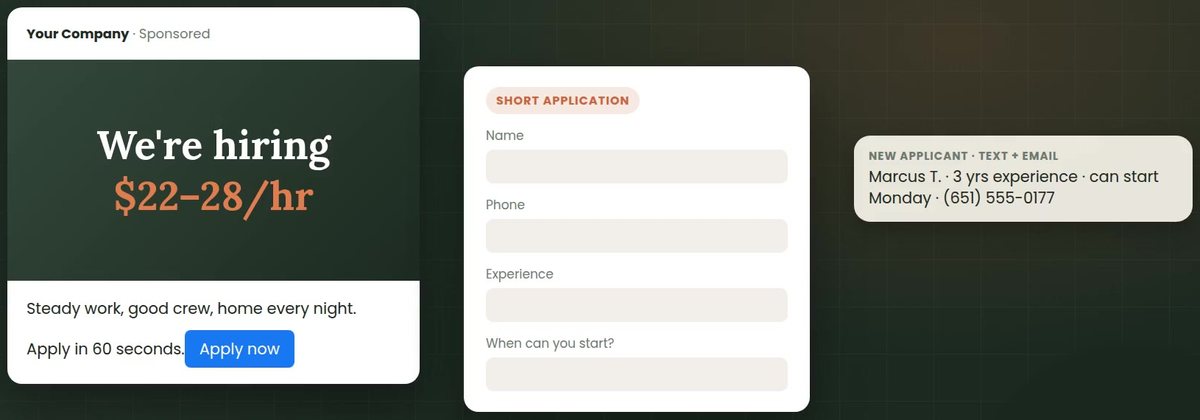
A job ad for HVAC service techs near you, with every applicant sent to your phone.

Example conversation.
What works in 2026 for HVAC contractors who want more booked calls without buying leads: the website, the marketing calendar and the phone, in that order. Use it whether or not you ever work with us.
On this page: Website · Marketing & ads · Phone calls · FAQ · Sources
Give AC repair, furnace and heating repair, heat pumps, new system installs, ductless mini-splits and maintenance plans their own pages. Homeowners search for the problem they have, and Google and AI tools match a search to the page that answers it. A single “Services” page with a bulleted list rarely ranks for any of them.
List your service area by town or county, and write a short page for each major one with the neighborhoods, typical housing stock and response times there. Keep your business name, address and phone number identical on the site, your Google profile and every directory, so search engines trust they all describe the same company.
Show your license number, insurance, EPA 608 certification, the equipment brands you install and real reviews near the top of the home page. A homeowner whose furnace quit at 10 pm is choosing between three tabs; the one that looks established and local gets the call.
Most HVAC searches happen on a phone, often in a hot or cold house. Put a tap-to-call button in the header of every page, a short request form for people who would rather type, and your hours plus what happens after hours. Test the site on a phone with bad signal: it should load in a couple of seconds.
The federal 25C and 25D credits ended for work after December 31, 2025, and new systems moved to A2L refrigerants [10][11]. Pages that still promise a federal heat-pump credit or talk about R-22 make you look out of date. Review your install and financing pages every spring and fall.
Choosing who builds it? 18 website options compared, with first-year costs and who owns the site.
Pick HVAC contractor as the primary category, add every service you actually do, upload real job photos monthly and post seasonal offers. Answer the questions people ask on the profile. For many homeowners this is the first and only thing they see before they call.
Recency matters more than lifetime count: most consumers weigh reviews from the last three months most heavily [7]. Text the review link while the tech is still in the driveway and the house is comfortable again. Reply to every review, good or bad, in a calm, specific way.
Run AC tune-up campaigns two to four weeks before your first hot stretch and furnace checks before the first freeze. Peak-season ads mostly bid against everyone else for emergency calls you would get anyway; shoulder-season ads fill the calendar with maintenance and replacement leads that are cheaper to win.
Local Services Ads charge per lead, search ads charge per click, and Google is moving Local Services advertisers in HVAC into Performance Max from August 2026 [12]. Whatever mix you use, track cost per booked job, not cost per lead, and dispute junk leads every week.
Agreements smooth out the slow months, give you a reason to see the equipment twice a year and turn into replacement jobs when the system ages out. Offer the plan on every repair invoice, and send renewal reminders a month before each tune-up season.
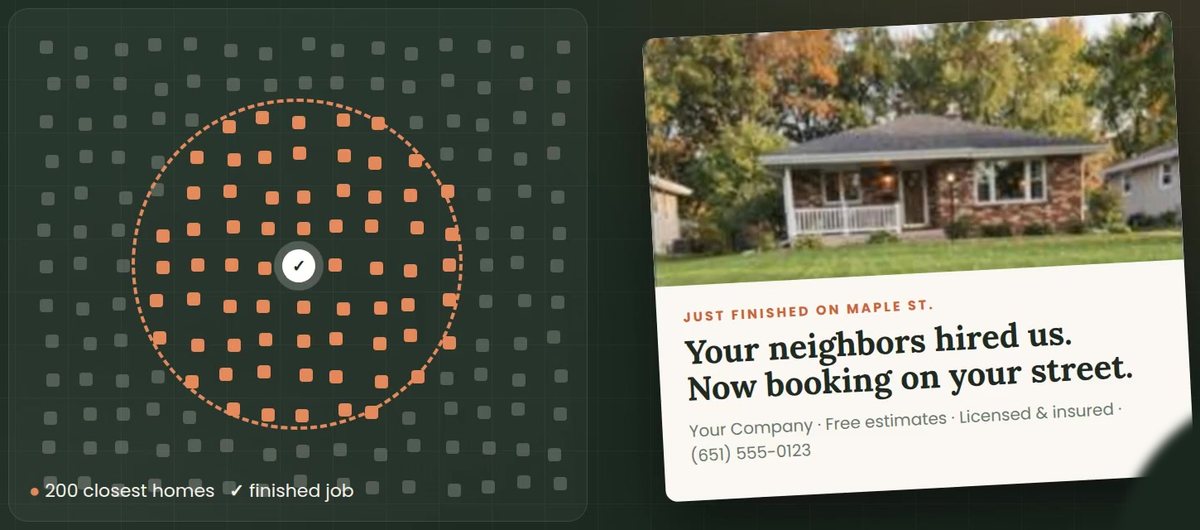
Neighbors share builders, house ages and often the same failing equipment. A postcard to the closest 100–200 homes after a replacement, with a photo and a short offer, reaches people at the moment their own system is on their mind. Outfitter sends these for about 53¢ each.

Choosing where to spend? 26 marketing options compared, including which leads are shared with other contractors.
Only about half of home-services calls reach a person [1], and HVAC after-hours share climbs sharply in summer [2]. Every unanswered no-cool call in July is a repair, and possibly a replacement, that goes to whoever picks up. Forward unanswered calls to a person or an AI receptionist rather than voicemail.
Ask whether it's heating or cooling, what the system is doing (not running, running but not cooling, leaking, noises), roughly how old it is, and whether anyone at home is vulnerable to heat or cold. Those answers decide urgency, which tech to send and what parts to put on the truck.
Many answered calls never get asked for the appointment [1]. Offer two specific windows, confirm the address and the best callback number, and text a confirmation. If you can't commit a time, set the callback time and keep it.
Give the diagnostic or trip fee up front, explain after-hours rates plainly and never quote a repair you haven't seen. For replacements, offer good, better and best options with financing, and leave the customer a written quote they can compare.
Replacement decisions often take days and a spouse's sign-off. Call or text within two days, again a week later, and once more before the season turns. Track your close rate by tech and by lead source so you know which calls are worth paying for. Outfitter's Front Desk texts you every call so none slip.
Choosing an answering service? What it should ask and which ones fit this trade, from live answering to AI.
Start with the calls you already get. Only about half of calls to home-services companies reach a live person, so answering every call, including after hours, is the cheapest new business you’ll find.
Then make it easy to choose you: steady, recent Google reviews, a website that names the services you do and the towns you serve, and tune-up ads timed before each season. Outfitter’s website is free, and Front Desk and marketing are free to join; you pay only for what runs.
Usually, if you miss calls. Front Desk costs 35¢ a minute from your token balance, and $35 covers about 100 minutes, or roughly 18 typical calls. The average HVAC repair ticket was about $1,205 in 2025, so one saved no-cool call pays for months of answering.
It answers, collects the details and marks no-heat, no-cool and leak calls urgent, then texts you right away so you decide who goes. It never promises same-day service or quotes a price unless you told it to.
You also tell it what to say on safety calls. For a gas smell or a carbon monoxide alarm, most owners have it tell the caller to leave the house and call the gas utility or 911 first.
Yes. Front Desk says it’s an AI assistant at the start of every call. It can answer in a natural voice or in your own voice, cloned only from a recording you make yourself. Callers hear your voice but are never misled about who’s talking.
Yes. Your Google profile gets you on the map, but your website is where homeowners and AI tools check what you actually fix, which brands you service, your service area and whether you offer maintenance plans. Outfitter builds one for free in about 5 minutes.
The same things help both: a steady stream of recent reviews, the same business name, address and phone number everywhere, a website that names each service and the towns you cover, and regular posts on your Google profile. Website Professional automates your Google review requests and posts.
They can be, because you pay per lead rather than per click, but they’re changing. Google says that starting in August 2026 it is moving U.S. Local Services advertisers in categories including HVAC into Performance Max campaigns, so expect your setup and reporting to change. Your website and reviews keep working no matter how Google packages its ads.
Ask after every job, the same day, while the house is comfortable again. 74% of consumers care about reviews from the last three months, and 47% won’t use a business with fewer than 20, so a steady ask beats a once-a-year push. Emma sends the request for you.
Set a monthly amount you’re comfortable with and judge it by cost per booked job, not clicks. With Outfitter you choose the ad spend and can change it any time. Ads run at cost plus 30%, your first $10 of Facebook ads is on us, and there’s no contract.
Sell maintenance plans and tune-ups before the weather turns: AC tune-up ads ahead of the first hot week, furnace safety checks before the first freeze, renewal reminders to past customers, and postcards to neighborhoods with older systems. Emma times these to your climate.
Put the pay and schedule in the ad, and spell out what you need, like EPA Section 608 certification and a driver’s license. The BLS projects about 40,600 openings a year for HVAC mechanics and installers, so vague ads lose. Emma runs your job ad on Facebook and Instagram and sends every applicant to your phone.
Since January 1, 2025, new home AC and heat-pump systems can’t be made with refrigerants above a global-warming potential of 700, so new equipment uses A2L refrigerants like R-454B or R-32. A 2026 EPA rule lets contractors keep installing R-410A equipment that was already built until supplies run out. Some states are stricter: New York bars new R-410A installs.
Not for new work. The 25C and 25D federal credits don’t cover work done after December 31, 2025. Utility and state rebates may still apply, so check what’s offered where you work and take any federal-credit promise off your website.
You don’t need any of them. Every call, request and applicant comes to you by text and email, so Outfitter works alongside whatever field-service software you use.
No catch. The free website lives at getoutfitter.ai/site/your-name with a small Outfitter banner, free forever. Website Professional is $79 a month for your own web address, no banner, and automated Google reviews and posts, with 30 days free and no contract. You keep ownership of your business data.
Figures on this page come from these reports. Vendor research is labeled as such; government sources are primary.
Start with your HVAC website. It’s live in about 5 minutes. Marketing is free to join, and you pay only for what runs. No contracts.