October 5, 2026 · St. Paul, Minnesota
Outfitter AI Gives America’s Smallest Contractors One Number to Call for Their Whole Office
Millions of tradespeople run a business and do the work themselves. Outfitter AI gives them an AI office they reach with a phone call, one that gets smarter every time any contractor on the system wins a job.
The business behind every repair
Behind every fixed furnace, new roof and finished basement is a small business, and most of them are very small. More than 5.2 million people work for specialty trade contractors in the United States, according to the Bureau of Labor Statistics: plumbers, electricians, roofers, HVAC technicians, painters and the rest. Census Bureau figures count nearly 2.9 million construction businesses with no paid employees at all, where the owner is the whole company. Together they serve a home improvement and repair market that Harvard’s Joint Center for Housing Studies projected at $509 billion for 2025.
Most of these owners spend the day on a ladder, under a sink or in their truck. The office work waits until night, in the hours that should belong to their families, and the calls they miss during the day become jobs for someone else. Call-tracking firm Invoca found that 27 percent of calls to home service businesses go unanswered.
A pile of logins, or one phone call
The usual answer has been more software: a website builder, an ads manager, a review tool, an answering service, a scheduling app. Each comes with its own login, dashboard and monthly bill, and each assumes the owner has time to sit at a desk.
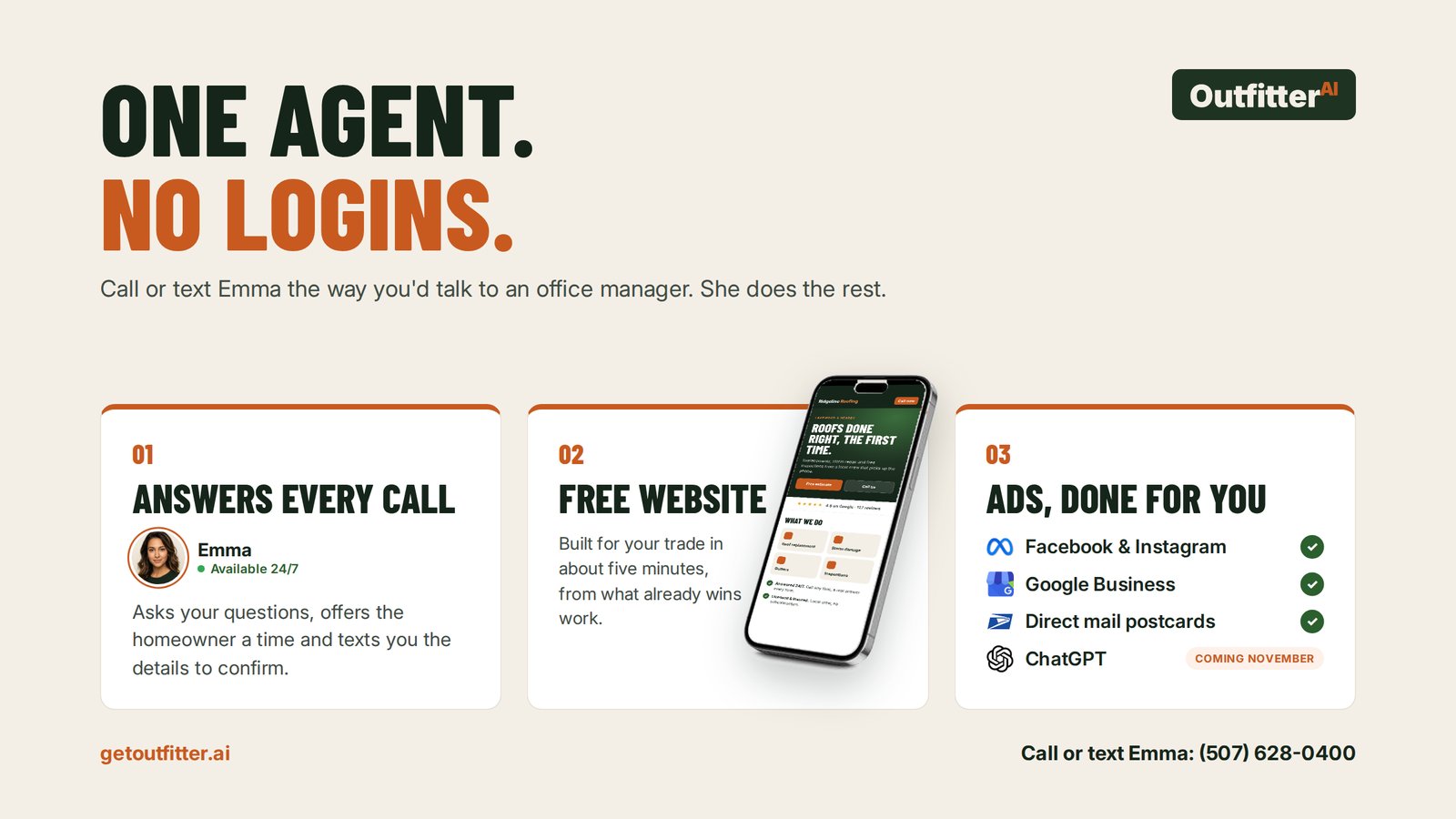
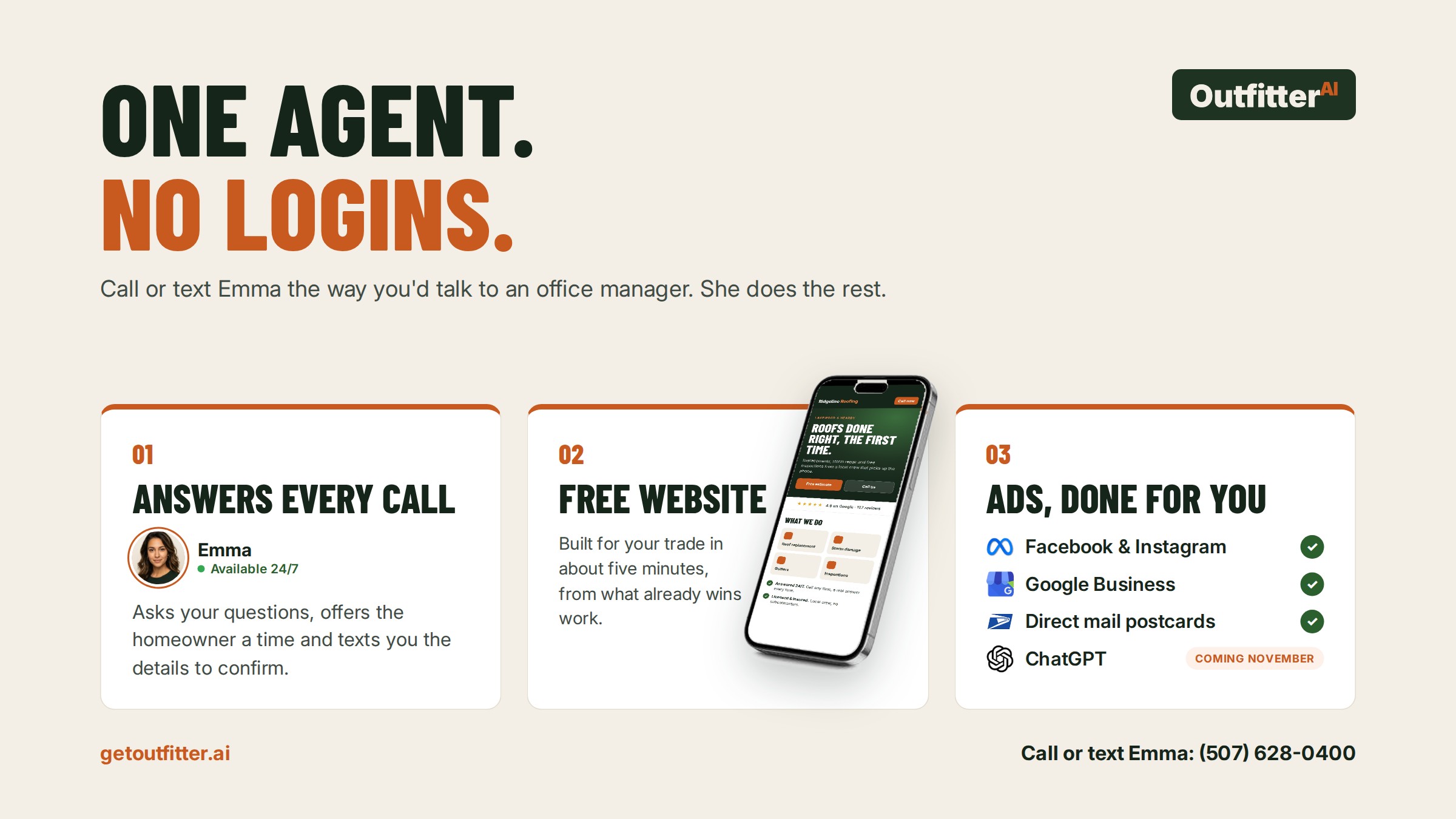
Outfitter AI takes the opposite approach. It was founded in St. Paul, Minnesota by Eric Smith, who built Clockedin, a mobile platform for blue-collar workers to pick up on-demand shifts, before running his own general contracting business. Each business gets one AI agent, Emma, who learns the trade, the towns and the way the owner works in a short phone conversation. From then on, the owner calls or texts her the way he would talk to an office manager: “Mail postcards around the Johnson job.” “Put fall cleanups on the website.” She handles it. There is nothing to log into.
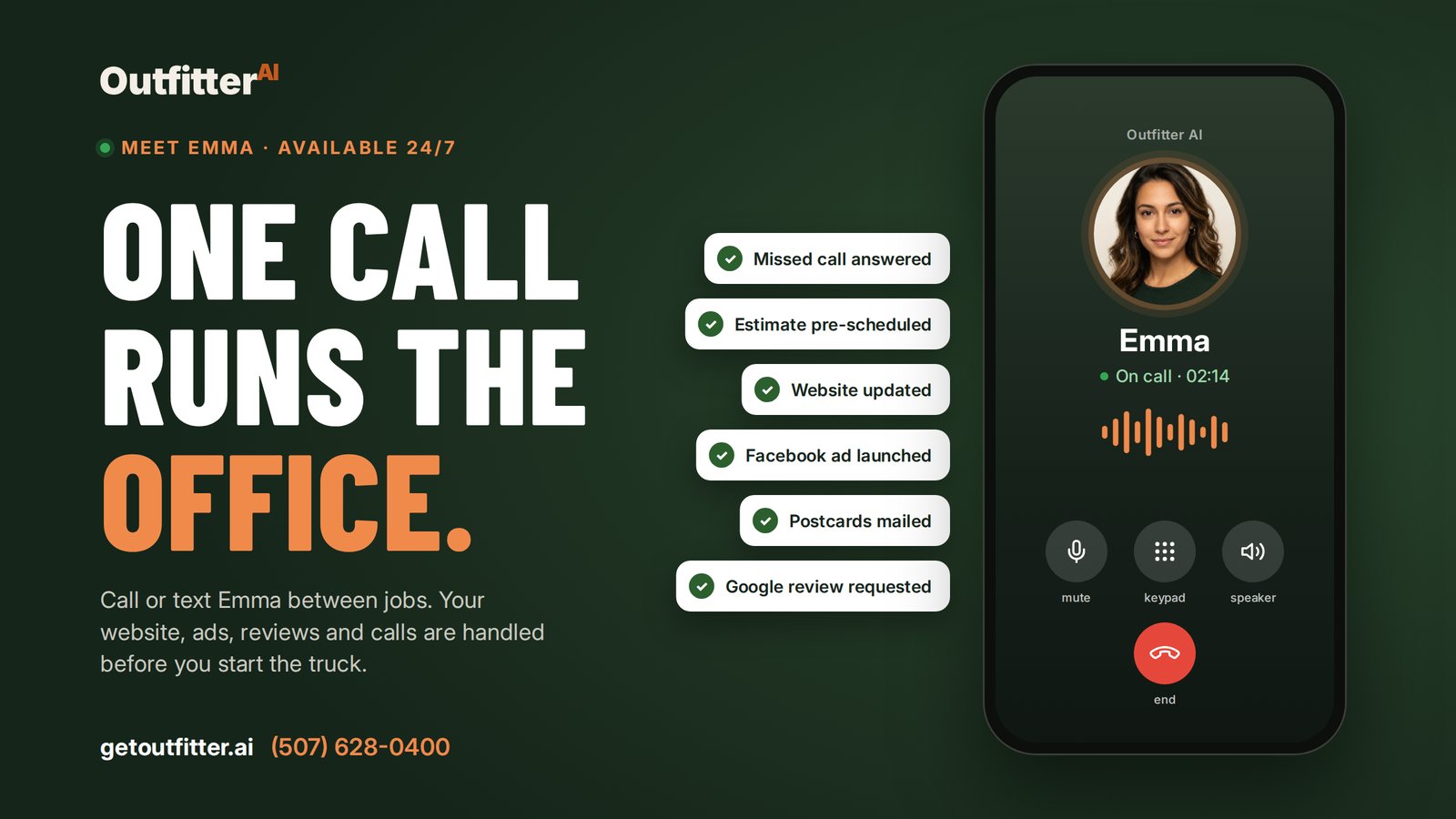
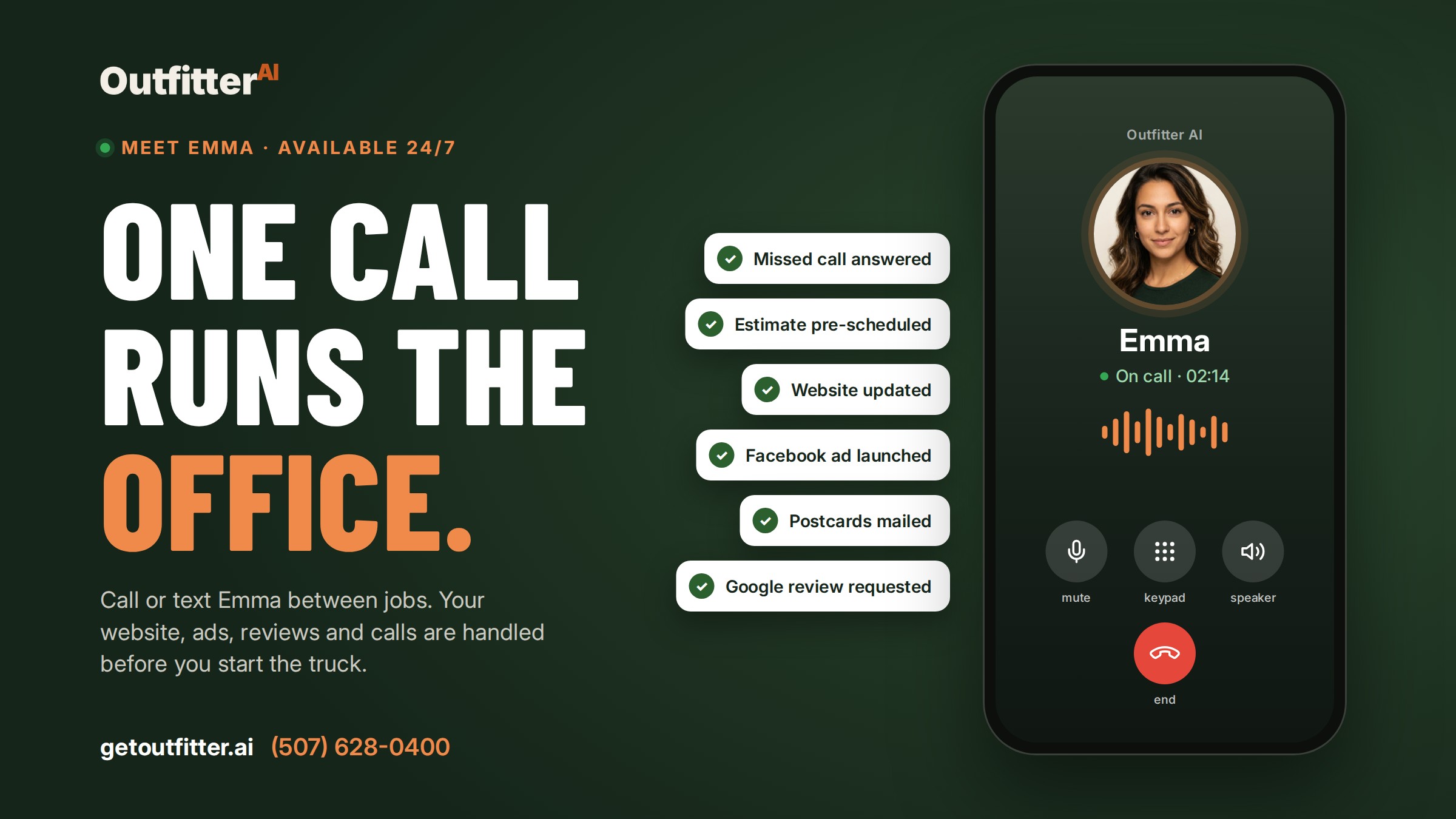
When the owner can’t pick up, Emma answers his calls, asks his questions, offers the homeowner a time and texts him the details to confirm. The roofer two stories up doesn’t lose the estimate.
Emma also takes on the two jobs most owners never get to. She builds a free website in about five minutes over the phone, drawing on Outfitter AI’s research into thousands of websites that already win work in that trade, so a new painter’s site starts from what works for painters instead of a blank template. And she runs his Facebook advertising for him, turning finished jobs into local ads that show up in the feeds of homeowners nearby. He doesn’t write the ad, pick the audience or learn Facebook’s ad tools.
“Contractors don’t want to learn marketing. They want booked jobs,” Smith says. “So we stopped building dashboards and gave them someone they can call.”
Every contractor makes the system smarter
A single contractor has no way to know which ad gets more calls or which website layout turns visitors into estimate requests. Large companies pay marketing teams to test that. A one-truck shop never finds out.
Outfitter AI sees what is working across every shop on the system. When one roofer’s ad starts pulling more calls, or one website version turns more visitors into requests, Outfitter AI can roll that improvement out to every contractor it fits. A painter in Minnesota benefits from what worked for a landscaper in Texas the week before, without running a test or hiring an agency.
“Every contractor on Outfitter makes it better for every other one,” Smith says. “A solo roofer gets the lessons of every shop on the system without ever opening a report.”
Built for the one-truck business
Artificial intelligence has mostly been sold to large companies with software teams and big budgets. Outfitter AI was built for the other end of the market. It is free to join, the basic website is free, and owners pay only for what runs, with no contracts or retainers.
“A one-truck roofer deserves the same office and marketing a big company has,” Smith says. “AI finally makes that possible, and it shouldn’t cost them a retainer to get it.”
Emma doesn’t climb the ladder or fix the pipe. She takes everything else off the owner’s plate, and she keeps getting better, because every contractor on the system is teaching her what works.
Sources: Bureau of Labor Statistics, Specialty Trade Contractors (NAICS 238), September 2026: 5.28 million employees. U.S. Census Bureau, 2022 Nonemployer Statistics: 2,875,590 construction businesses with no paid employees. Harvard Joint Center for Housing Studies, remodeling outlook: $509 billion projected for 2025. Invoca, 2024: 27% of calls to home services businesses unanswered.