When the pollen settles and the north side turns green, homeowners all call in the same three weeks. You’re on a ladder with a surface cleaner running and can’t hear the phone. Outfitter gives your wash business a website that explains soft washing in plain words, an AI Front Desk that takes the calls you miss, and local ads and Google reviews that Emma, your AI agent, runs for you.
Call or text Emma the way you’d talk to an office manager. She does the rest.
Asks your questions, offers the homeowner a time and texts you the details to confirm.
Built for your trade in about five minutes, from what already wins work.
Six figures to know before you print another yard sign. The source behind each one is listed at the bottom of the page.
Most wash calls arrive in a few hot months, then the phone goes quiet when it freezes. Emma lines your ads up ahead of the rush and keeps work coming in the shoulder months.
Green siding and pollen-covered decks send everybody to the phone at once. House-wash ads start before the first warm Saturday. Front Desk catches every call you miss on the rig and texts you the address and surfaces.
Graduations, reunions and home sales keep the driveway and patio work coming. A review request goes out the same day the concrete dries. Postcards go to the street where you just finished a house.
Pre-holiday house washes, gutter brightening and roof stain removal. Commercial ads for storefronts, drive-thrus and dumpster pads keep the trailer moving.
In cold climates the rig sits. Emma runs early-booking ads for spring and posts job ads so a new wash tech is trained by March. In warm states, she keeps the house-wash ads running.
A wash company in Tampa can work most of the year. One in Minneapolis drains its pumps by Thanksgiving. Emma times your ads to your freeze dates, not someone else’s.
You can’t answer with a wand in one hand and a ladder in the other. Front Desk picks up the calls you can’t, on your number or a new local one, asks your questions, pre-schedules a time and texts you everything so you can quote it tonight.
Example call. Front Desk follows the rules you give it.
97% of consumers read reviews before they pick a local business, and 45% have used an AI tool like ChatGPT to find one. Wash companies that keep landing in those answers have a steady stream of new reviews and a site that names every surface they clean.


Tell Emma what you clean and where. About 5 minutes later, your wash site is up. Want a change? Text her: “Add a spring house-wash plus driveway bundle.”
Three changes that hit wash companies over the last two seasons. Know them before a customer, an inspector or a water district asks.
On wash water: Portland, Oregon, requires a Mobile Washer Discharge Authorization before wash water goes to the sanitary sewer, and Brookhaven, Georgia, cites the Clean Water Act in banning polluted wash water from storm drains. Check your city’s stormwater office before you set up recovery. [4] [5]
The closest federal job category, cleaners of vehicles and equipment, had a median wage of $17.23 an hour in 2025, with about 56,200 openings projected each year. Industry estimates put the average pressure washing wage near $27 an hour, so good techs know their worth. [2] [3]

Call or text one number. Emma, your AI agent, runs your website, your ads, your phones and your hiring, set up for your pressure washing company.
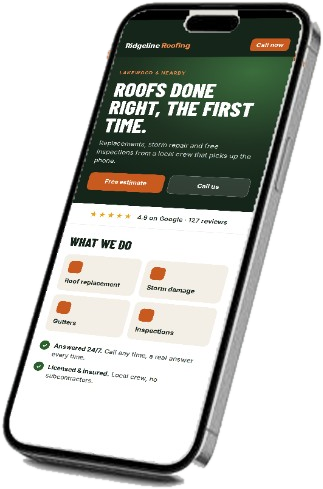
House washing, soft washing, roofs and concrete laid out the way homeowners search for them.
House-wash ads before the spring rush, review asks after every job, postcards to the neighbors.
Picks up while the pump is running, asks for surfaces and stories, and pre-schedules a time for you to confirm.
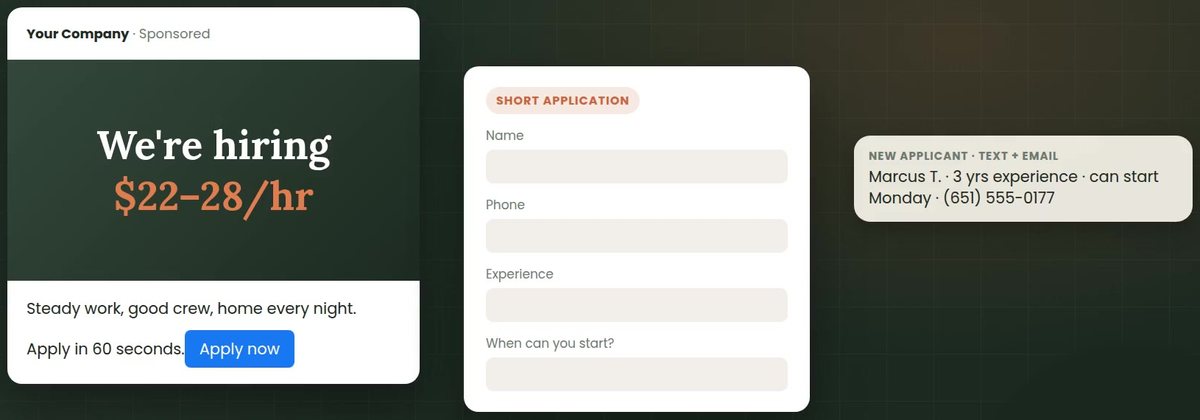
A job ad for wash techs in your area, with every applicant texted to you.

Example conversation.
A field-tested playbook for owners of pressure washing and soft wash companies: how to build a site that sells clean surfaces, where ad money works in a short season, and how to turn a phone call or a photo into a booked wash.
On this page: Website · Marketing & ads · Phone calls · FAQ · Sources
Build separate pages for house washing, roof soft washing, driveways and concrete, decks and fences, gutters, and commercial flatwork. Each page should say what method you use on that surface, what it removes (mildew, algae streaks, oil, rust) and roughly how long it takes. A homeowner searching “roof black streaks” should land on your roof page, not a generic list.
The number-one fear is damage: stripped paint, etched wood, water forced behind siding. Write a short section on when you use low pressure and cleaning solution versus a surface cleaner at high pressure. Fixr puts soft washing at $0.25 to $0.35 a square foot and pressure washing at $0.30 to $0.80 [1], so the method also explains your price.
Shoot the same angle before and after, in the same light, on every job. Label each pair with the surface and town: “Vinyl siding, two-story, Maple Grove.” Real photos of green siding turning white do more selling than any paragraph, and they give Google and AI tools something specific to match to searches.
Many wash jobs can be priced from pictures. Put a form on the site that asks for the address, the surfaces, the number of stories and three or four photos taken from the street and the driveway. Promise a reply time you can keep. A homeowner who sends photos at 9 pm is ready to book.
Cities enforce Clean Water Act stormwater permits against dirty runoff. Brookhaven, Georgia, allows fines of up to $1,000 per violation per day [4]. A line about how you protect storm drains, recover water on commercial jobs and use plant-safe practices tells property managers and HOAs you won’t get them in trouble.

Choosing who builds it? 18 website options compared, with first-year costs and who owns the site.
Wash demand arrives in a burst once pollen falls and mildew shows on the north side. Launch house-wash and driveway ads before that, not after your phone starts ringing, so you’re filling April instead of scrambling. Pull ad spend back once you’re booked out three weeks, and shift it to fall pre-holiday washes later.
A surface cleaner cutting a clean stripe across a dirty driveway is the most-watched clip in home services for a reason. Post short vertical videos from real jobs with the town in the caption. Run them as ads to homeowners within your drive radius, and send the clicks to a page with the photo-quote form.
Customers are most impressed in the first hour. Send the review link the same day, ideally with the before-and-after photo attached. BrightLocal found 74% of consumers weigh reviews from the last three months [9], so steady requests through the season beat a once-a-year push. Outfitter’s Website Professional sends those requests automatically.
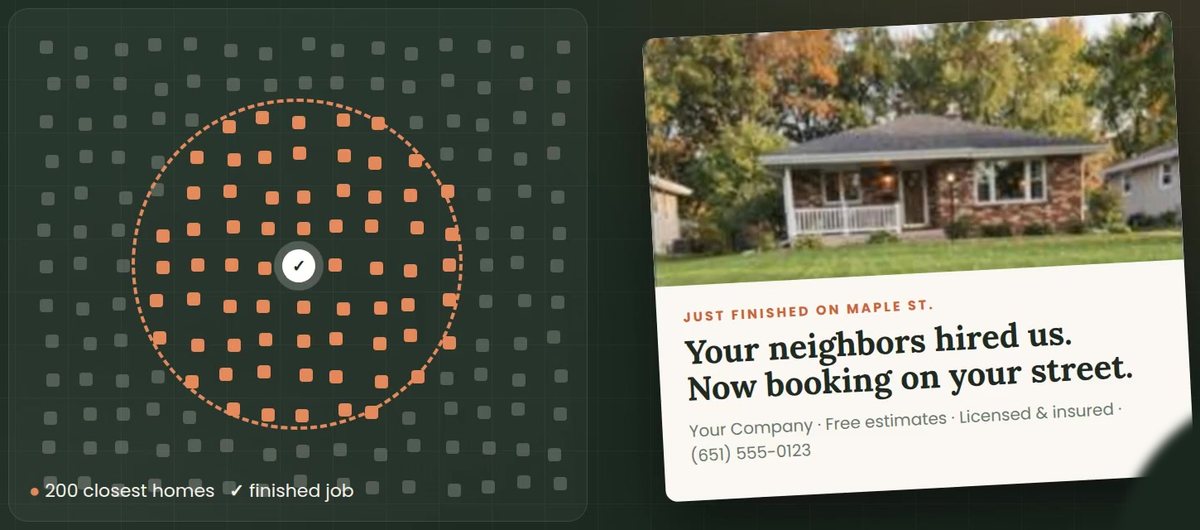
A clean house makes the neighbors’ siding look worse. After each job, leave door hangers or mail postcards to the nearest 100 to 200 homes with a photo of the house you just did. Offer a same-day add-on price if two neighbors book together, which saves you a second trailer setup.
House washes, gutters and driveways all come back every year. Offer a yearly plan that books the customer for the same month next season at a set price. It smooths out your spring rush, gives you a list to remind in winter and raises the value of every new customer you win.
Write down where each job came from: Google, Facebook, a yard sign, a neighbor. Divide what you spent on each source by the jobs it produced. With an average house wash near $700 [1], a channel that costs $80 per booked job is great; one that costs $300 for a $150 driveway is not.
Choosing where to spend? 26 marketing options compared, including which leads are shared with other contractors.
You can’t hear a phone over a gas engine and a surface cleaner. Invoca found 55% of home-service businesses don’t even ask callers to book [10], so a caller who reaches anyone who asks for the job is ahead. Forward missed calls to an office person, an answering service or Outfitter’s Front Desk during the busy months.
What surfaces need cleaning? What is the siding or roof made of? One story or two? Is there a deadline, like a party, a listing or an HOA letter? Can you text photos? Those answers let you price most jobs without driving out, and the deadline tells you which calls to return first.
Give a firm range from the photos and say what could change it: heavy oxidation, rust, oil stains, or more square footage than it looked. Homeowners accept a range when you explain it up front. They don’t accept a surprise when you knock on the door with a higher number.
End every call with a specific day and time, or a time you’ll call back with the quote. In spring, offer the next two openings rather than asking when is good. Someone who says “let me think about it” in April usually books whoever calls back first.
Text the photo-based quote with a link to your before-and-after gallery, then follow up two days later. Mention the weather window or your next opening on their street. Many wash quotes die simply because nobody followed up, not because the price was wrong.
Choosing an answering service? What it should ask and which ones fit this trade, from live answering to AI.
Catch the spring rush instead of chasing it. Start house-wash ads a couple of weeks before pollen season, answer every call while you’re on a job, and send a review request the day you finish.
Then work the street. After a house wash, the neighbors’ siding looks dirtier by comparison. Postcards to the closest homes cost about 53 cents each delivered.
Front Desk costs 35 cents a minute from your token balance, and a token is one cent. A typical wash inquiry is short: what surfaces, what siding, how many stories, when they want it. Put $35 in and you get roughly 100 minutes of answered calls.
Compare that with an average house wash of about $700 (Fixr). Catching one extra job in April pays for a lot of answering.
Many owners do, especially for driveways, fences and house washes. Front Desk collects the details you ask for and can tell callers you’ll text them for photos. It never gives a price itself unless you told it to.
For roofs, stucco or anything with oxidation or rust, you may still want to see it in person. You decide what Front Desk tells callers.
Usually not the storm drain. Storm drains often run straight to creeks and lakes, so cities treat dirty wash water as pollution under their Clean Water Act stormwater permits. Brookhaven, Georgia, for example, allows fines of up to $1,000 per violation per day.
Common options are letting clean water soak into grass or gravel, vacuum recovery, or the sanitary sewer with permission. Portland, Oregon, requires a Mobile Washer Discharge Authorization for that. Call your city’s stormwater office before you pick a setup.
It depends on where you work. Most places require a general business license and insurance. Some go further: Westchester County, New York, has required power washing operators to be licensed since July 1, 2025.
Soft washing adds chemicals to the mix, so check your state’s rules on handling and disposal too.
Use both, and explain the difference. Homeowners search for pressure washing even when their siding or roof needs a soft wash. A page that says you use low pressure and the right cleaner on siding and shingles, and high pressure on concrete, answers their biggest worry: will this damage my house?
Fixr puts soft washing at about $0.25 to $0.35 a square foot, so it’s worth naming.
Yes. Front Desk asks the questions you set, like surfaces, siding type, stories and deadlines such as a party or an HOA notice. It pre-schedules a time for you to confirm and texts and emails you every message.
If a caller has an urgent problem, such as a slippery mold-covered walkway or a deadline from an HOA, you can tell Front Desk to mark it urgent.
Yes. Every call opens with Front Desk telling the caller it is an AI assistant. You can give it a natural voice or your own voice, cloned only from a recording you make. Callers hear a familiar voice and still know exactly what they’re talking to.
Yes. Your Google profile puts you on the map and Facebook shows off before-and-afters, but your website is where people and AI tools check what surfaces you clean, whether you soft wash, and which towns you cover. Outfitter can set one up free in about 5 minutes.
Ask right after the job, while the driveway still looks brand new. BrightLocal found 74% of consumers care about reviews from the last three months, and 47% won’t use a business with fewer than 20. Website Professional sends the request for you after every job.
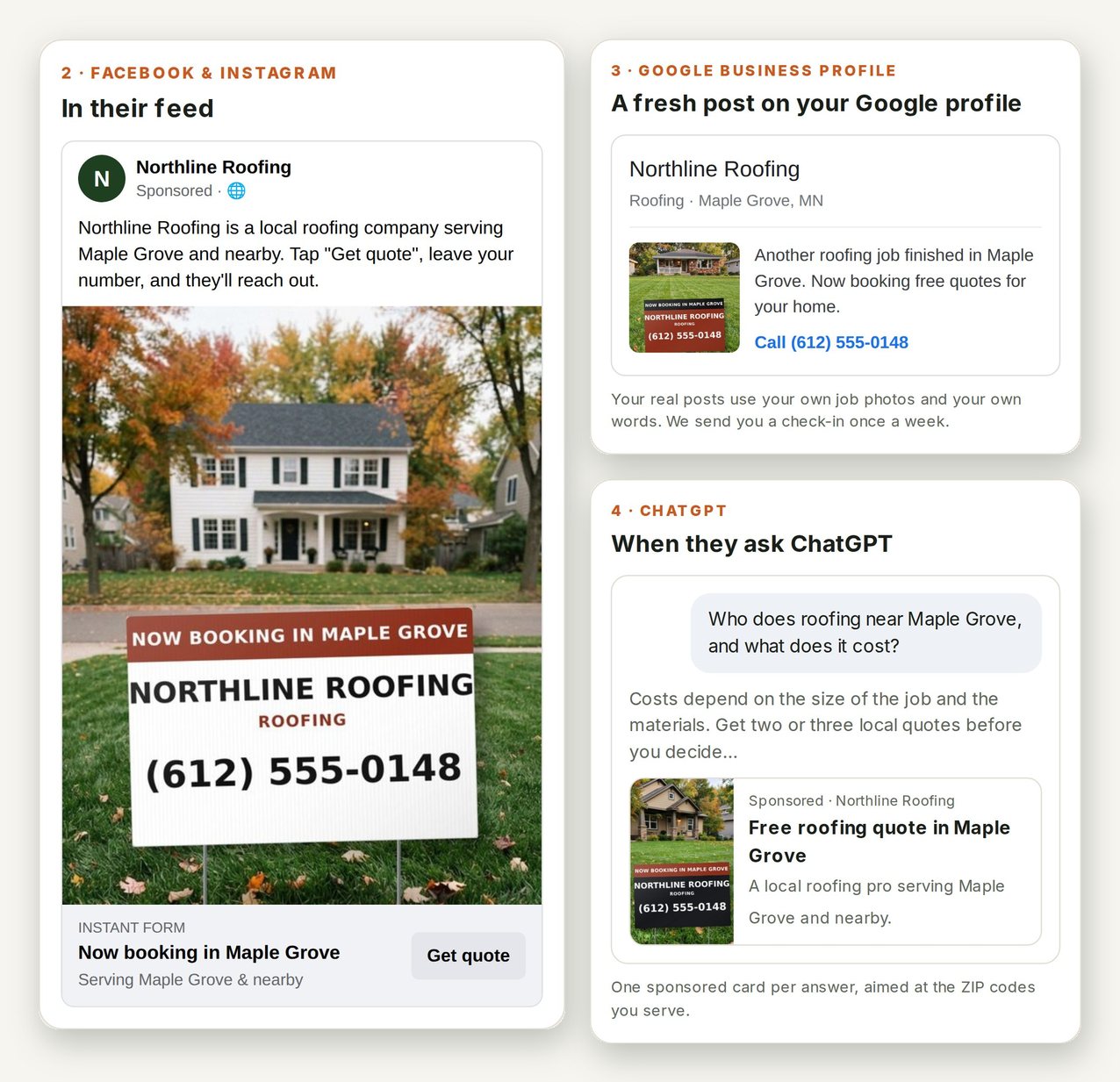
They can, because pressure washing is visual. A before-and-after of a driveway stops the scroll. With Outfitter you set the budget, ads run at ad cost plus 30%, the first $10 of Facebook ads is on us, and you can pause any time. Run them hardest in the weeks before your spring rush.
In cold climates, use winter to fill spring: early-booking ads, reminders to last year’s customers and job ads for the next season’s crew. In warm climates, keep house washing going and add commercial work like storefronts, drive-thrus and dumpster pads.
Put the pay, hours and season length in the ad, and say what the job really involves: ladders, roofs, towing a trailer and handling soft-wash chemicals safely. Industry estimates put the average pressure washing wage near $27 an hour. Emma puts your wash tech ad on Facebook and Instagram, and each applicant lands on your phone.
Both lean on the same signals: recent reviews, the same name, address and phone everywhere, and a website that names each service and each town. Website Professional automates your Google review requests and posts, and ChatGPT ads are coming in November.
Yes. It runs at getoutfitter.ai/site/your-name, carries a small Outfitter banner, and you never get a bill for it. If you want your own domain, no banner, and Google review requests and posts on autopilot, Website Professional costs $79 a month after 30 days free, with no contract. Your business data stays yours.
Figures on this page come from these reports. Vendor research is labeled as such; government sources are primary.
Start with a website made for pressure washing, live in about 5 minutes. Marketing costs nothing to join; you pay only for the ads and calls that run. No contracts.