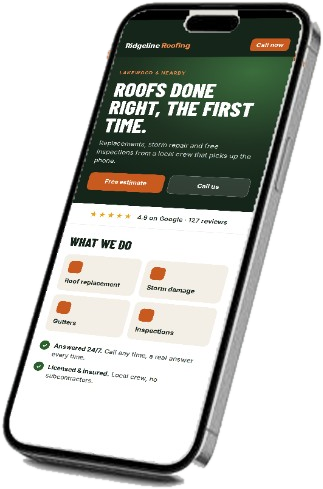
Remodelers spend the day behind a dust wall with a saw running, which is exactly when the homeowner with a 1950s ranch calls. Outfitter gives your renovation company a website that shows your before-and-afters, an AI Front Desk that picks up the calls you miss, and local ads and reviews handled by Emma, your AI agent.
Call or text Emma the way you’d talk to an office manager. She does the rest.
Asks your questions, offers the homeowner a time and texts you the details to confirm.
Built for your trade in about five minutes, from what already wins work.
Six data points from housing researchers and remodeling surveys, each linked to its source at the bottom of the page.
Homeowners plan in the dead of winter, sign in spring, and go back indoors in the fall wanting the basement or main floor done by the holidays. Emma times your ads and postcards to each swing.
Whole-floor and older-home remodel ads go live. Front Desk catches calls while you’re mid-demo and pre-schedules walkthroughs for you to confirm.
Postcards hit the blocks around each finished house. Review requests go out at punch-list sign-off, while the homeowner is still showing it off.
Basement finishing and family-room ads run as people move back indoors. Front Desk flags water and leak calls urgent, since a wet basement has to be fixed before it gets finished.
Interior jobs keep crews working. Hiring ads go out for helpers and carpenters, and Emma starts spring messaging to people who asked about bigger projects.
Your climate and housing stock set the rhythm. A remodeler working 1920s foursquares in the Upper Midwest has a different year than one doing 1990s tract homes in Arizona, and Emma plans for yours.
ServiceTitan’s 2025 trades survey named general remodeling among the trades where the most owners said they were struggling. Front Desk answers the calls you can’t take from inside a gutted room, asks your questions about the house, pre-schedules a walkthrough and texts it all to you.
Example call. Front Desk follows the rules you give it.
Nearly every consumer, 97%, reads reviews for local businesses, and 45% have asked an AI tool for a recommendation. Letting a crew tear into your house takes trust, and recent reviews with photos are how a remodeler earns it before the first visit.


Give Emma the basics and your site is up in about 5 minutes. Change it by text: “Add the Elm Street basement photos.”
Three changes that come up when you walk an older house this year. Get the answers on your site and into your phone screening, and you sound like the remodeler who reads the fine print.
For context: NAHB’s Q2 2026 index for moderate $20,000 to $50,000 remodels rose 4 points to 73, while $50,000-plus projects fell 3 to 64. Mid-size jobs are where the activity is. [11]
The BLS projects about 137,000 openings a year for construction laborers and helpers, with a median wage of $46,680 in May 2025. Harvard’s Joint Center reports that a majority of remodelers said skilled trade workers were in short supply in every year from 2015 to 2023. [6] [2]

Call or text one number. Emma, your AI agent, runs your website, your ads, your phones and your hiring, set up for your renovation company.
Basements, main floors and older-home work shown with real before-and-after photos.
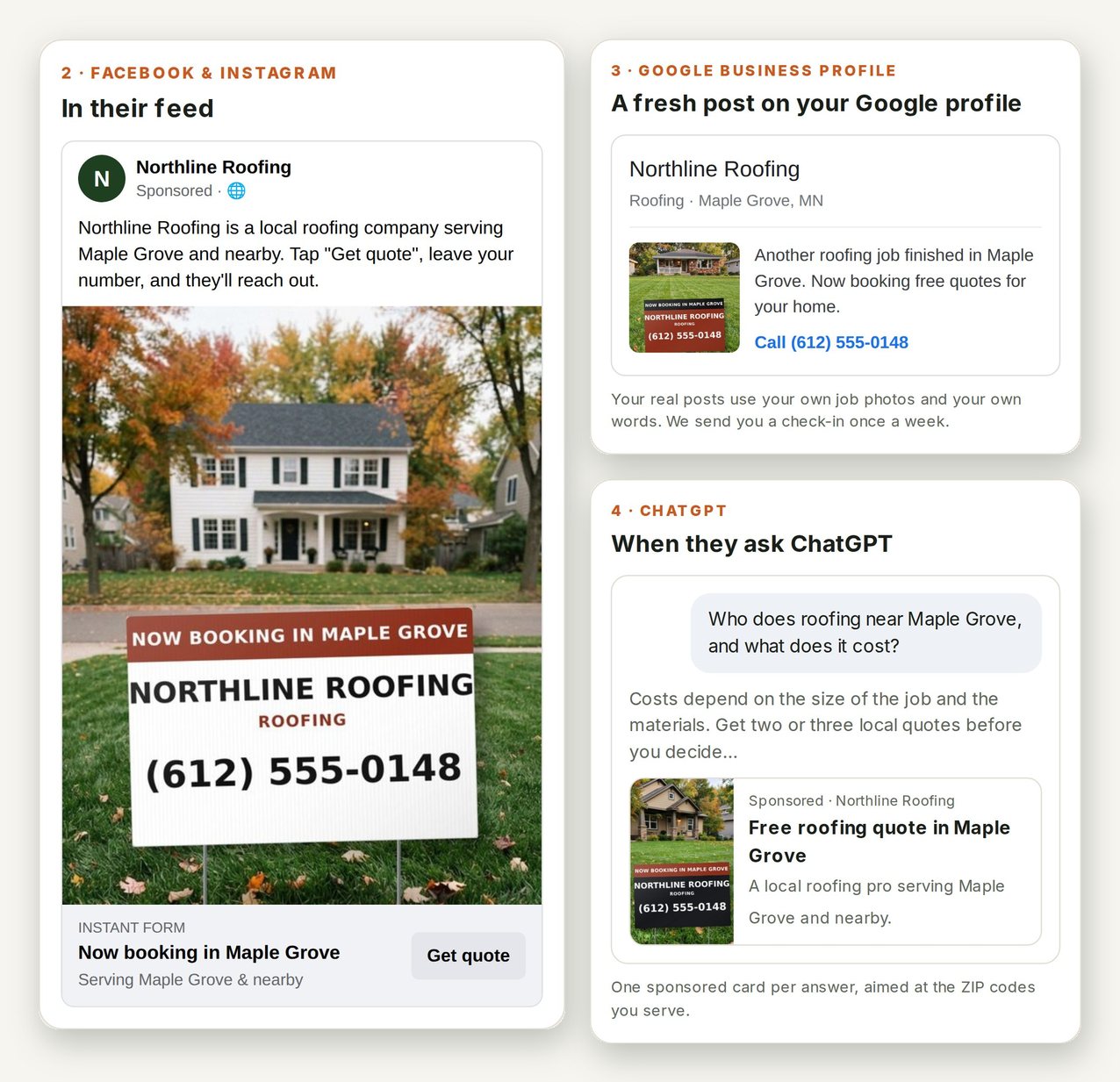
Spring remodel ads, fall basement ads, review requests at sign-off, postcards around finished houses.
Picks up while you’re mid-demo, flags leaks and water calls, pre-schedules walkthroughs.
Helper and carpenter job ads near you, every applicant sent to your phone.

Example conversation.
A working guide for owners of small remodeling companies: how to show your work online, where to market basements, main floors and older-home updates, and how to qualify and close a remodel over the phone.
On this page: Website · Marketing & ads · Phone calls · FAQ · Sources
Show the same corner of the room before and after, shot from the same spot. Caption each pair with the room, the town and one line about what changed, like “moved the laundry, added an egress window.” Stock photos make a remodeler look like a lead broker. Real dust-to-done pairs make you look like the crew.
Give basement finishing, main-floor remodels, attic or bonus rooms, and older-home updates their own pages. Explain what’s different about each: moisture and egress for basements, load-bearing walls for open floor plans, plaster, knob-and-tube and lead paint for older houses. Pages like these answer the questions people actually type.
The median U.S. home is 44 years old, and homes built before 1980 draw more improvement spending than newer ones [2]. Say which eras you work on most and what you find behind the walls. If you’re EPA lead-safe certified, put it on the page; paid work that disturbs paint in pre-1978 homes requires it [9].
Walk through your process in order: walkthrough, design and selections, written proposal, schedule, demolition, inspections, punch list, sign-off. Say how you protect the rest of the house from dust and how you communicate during the job. Living through a remodel is the homeowner’s biggest fear, so address it head-on.
Many homeowners can’t do the whole house at once. Describe how you split work into phases, such as basement first, kitchen next year, and what a sensible first phase includes. A visible phase-one path turns “we can’t afford all that” into a first contract instead of a lost lead.

Choosing who builds it? 18 website options compared, with first-year costs and who owns the site.
Post each finished remodel to your Houzz profile and Google Business Profile with five to ten real photos and the town name. Use the same company name, phone and service area on both. Steady new photos tell homeowners and search engines you’re active this year, not coasting on old work.
The moment the homeowner signs off on the punch list is the moment they’re happiest. Ask then, and text the link that evening. BrightLocal found 74% of consumers look for reviews from the last three months [1], so a remodeler who asks on every job, including small ones, keeps looking current.
Run basement and family-room ads as people move indoors in early fall, when they want space finished before the holidays. Push whole-floor and older-home remodels from late winter into spring, when plans turn into signed contracts. Target homes by age in the neighborhoods where your crews already work.
Credit cards now fund projects for 34% of renovating homeowners, per the 2026 Houzz & Home Study [3]. If you partner with a lender or offer payment plans, say so on your site and in your ads, with a line like “Ask about phased payments.” Financing keeps a $20,000 median-size remodel from shrinking to a paint job.
Houses on the same block usually share a floor plan and the same problems. Send postcards or door hangers to the nearest 100 to 200 homes showing the finished basement or kitchen wall you opened up. Outfitter mails postcards to the homes you choose for about 53 cents each.
Write down where each lead came from: Houzz, Google, a postcard, a referral, an ad. Then note which ones became walkthroughs and which signed. Spend more where signed jobs come from. In a cooling market, a remodeler who knows their cost per signed job can keep spending when competitors guess and cut.
Choosing where to spend? 26 marketing options compared, including which leads are shared with other contractors.
A homeowner who just bought an older house is calling three remodelers that afternoon. If you can’t step out of a dusty room, route calls to someone who can, or to an answering service that texts you the details. Call every missed lead back the same day, before another remodeler sets a walkthrough.
Ask the year the house was built, whether the basement has ever taken on water, and whether they know if a wall is load-bearing. Those answers tell you about lead-safe work, waterproofing and engineering before you drive out. Outfitter’s Front Desk can ask these same questions for you on calls you miss.
Ask what range they have in mind and whether they’re paying cash, financing or phasing it. The 2026 Houzz study found homeowners plan a median $15,000 for 2026 projects [3], so plenty of callers will want more than their budget covers. Offer a phase-one scope rather than ending the conversation.
Give two times, ask that everyone who’ll decide be home, and ask them to gather photos, old permits or inspection reports. Send a text confirming the time and what you’ll look at. A booked walkthrough is a next step; “we’ll be in touch” is usually a lost job.
Remodeling proposals stall on questions homeowners don’t want to ask. Call a few days after you send one and ask what’s unclear, then again at two weeks with a phase-one alternative if price was the issue. ServiceTitan’s 2025 survey found estimate follow-up brought in new revenue for 42% of surviving businesses [12].
Choosing an answering service? What it should ask and which ones fit this trade, from live answering to AI.
Show the work and answer the phone. Homeowners pick a remodeler from photos and reviews, so put real before-and-afters on your website, name the towns you work in and ask for a review at every sign-off.
Then stop losing the calls you already get. Front Desk answers when you’re mid-demo and texts you each lead with what the homeowner wants done.
Front Desk is 35 cents a minute from your token balance, and $35 covers about 100 minutes. The 2025 Cost vs Value report puts the average basement remodel at $52,012, so one caught basement lead covers a lot of answering. There’s no contract.
You decide what it asks: which rooms, how old the house is, the budget range, when they hope to start. It sends every answer to you by text and email, so you can see in seconds whether it’s a whole-floor job or a handyman call.
Yes. Front Desk introduces itself as an AI assistant at the start of every call. It can use a natural voice or a clone of your own voice, made only from a recording you record yourself.
Front Desk marks active leaks, sagging ceilings and water in the basement as urgent and texts you right away. It won’t promise anyone will be there today unless you’ve told it that’s OK.
If you’re paid to disturb painted surfaces in a home, child-care facility or preschool built before 1978, EPA says your firm needs lead-safe (RRP) certification, sole proprietors included. Put your certification on your website; owners of older homes look for it.
An EPA rule published November 12, 2024 lowered the dust-lead hazard level for pre-1978 homes and child-care facilities from 10 micrograms per square foot on floors and 100 on window sills to any level a recognized lab can report. It mainly affects lead inspections and abatement, but homeowners who read about it will ask how you contain dust.
Not federally for new work. The 25C energy-efficient home improvement credit doesn’t cover property placed in service after December 31, 2025. Check for utility or state programs where you work, and take any federal-credit promise off your website.
Ask at punch-list sign-off, on every job, not just the big ones. In BrightLocal’s 2026 survey, three in four consumers wanted reviews no older than three months, and 47% said they’d skip a company with under 20. Website Professional sends the request for you.
Yes. Profiles show a rating; your site shows the full story of a basement or main-floor project, your process, your certifications and your service area. That is what homeowners and AI tools read before they decide who to call.
Set a monthly amount and measure it by signed projects. You pick the spend with Outfitter and can change it any time. Ad spend is billed at cost plus 30%, and the first $10 of Facebook ads is free.
They say they plan to. The 2026 Houzz & Home Study found 54% of homeowners renovated in 2025 at a median $20,000, but the median they intend to spend in 2026 dropped to $15,000. Offering a clear first phase helps those budgets say yes.
Lead with the hourly pay and the hours, and describe the work honestly: demo, cleanup, drywall, trim. The BLS projects about 137,000 openings a year for construction laborers and helpers, so a clear ad stands out. Emma runs it on Facebook and Instagram and sends every applicant to you.
It runs alongside whatever you use. Every call, request and applicant reaches you by text and email, so nothing depends on an integration.
There isn’t one. Your free site runs at getoutfitter.ai/site/your-name with a small Outfitter banner, and it doesn’t expire. Upgrade to Website Professional for $79 a month to get your own domain, lose the banner and have Google review requests and posts sent automatically. The first 30 days are free, and there’s no contract.
Your business information belongs to you.
Figures on this page come from these reports. Vendor research is labeled as such; government sources are primary.
Begin with a remodeling site full of your before-and-afters; Emma has it up in about 5 minutes. There’s no fee to join the marketing, only the ad spend and call minutes you use, and no contract.